El Camino – Day 2

The clocktower plaza in Cea

The second day is often the hardest. Your body goes into shock upon realizing that it’s being asked to perform an encore of yesterday’s physical feat. That’s why I was thankful that (1) the hostel mandates that everyone leave by 8am — it kicked my butt into gear and forced me to move even though I felt incredibly lethargic — and (2) we had a short day ahead of us.

We left the albergue (hostel) right before 8, before sunrise, and got to the monastery in Oseira by 10:45. The walk took us up the hill with gorgeous vista of the gentle valleys below. The hills were scattered with large granite boulders of all sizes and shapes. We figured all the granite rocks that made up the stone houses and stone walls that criss-crossed the meadow must have come from these hills.

From the picture I’d seen of the monastery, I knew it was pretty large. But I hadn’t expected a palace. The massive stone walls rose up to the sky and appeared suddenly to our left. Three storied castle-like buildings with massive bell towers and intricately carved stone facades and tall walls surrounding the whole complex.

We took the opportunity to tour the site and learned about the history of the order (Cisterciens), how they started the monastery in the 12th century, and how the different parts of the monastery were built, rebuilt, added, and renovated throughout the ages. At some point the site was abandoned for almost 100 years and revived by the French who then returned it to the Cisterciens monks in 1929. It had been a horse stable, a jail, an orphanage, a corn farm, a champagnerie. And now only 11 monks live there, in that big giant complex by themselves!! They made herbal liqueur and cookies (for sale at the gift shop) and supplemented their income with the entrance fee for the tour and the albergue.

The arched walkway around one of the cloisters

Not many people choose to stop at this monastery, because it lengthens the route. Or if they do choose to visit, many prefer to walk another 10km the same day & stay in Dozón. I really wanted to experience staying at the monastery and luckily Gabriel and Pilar didn’t mind my idea. So we got to stay at this dormitory at the edge of the monastery where we were the only guests. The place was not heated so it was somewhat cold in the evening. There was a bathroom with two shower stalls and two toilets and I just couldn’t imagine how it’d work if the whole dormitory was filled with 48 people. Imagine the lines for the bathroom!!

I kept expecting people to welcome us effusively at the hostel, like we’re the poor tired pilgrims in need of tender, loving care. Not because what we’re doing is so hard but because I had thought people would assume we have been walking for hundreds of miles already (since we’re in the last “stage” of the full Camino). But so far people are pretty non-chalant and aloof, some downright gruff, like the man at the albergue in Cea. He barely said a word to us, grunting when he asked for our credentials (pilgrim passport). Same with the monastery. I had expected a monk in full robe to greet us. Nope. Just a guy – who does live at the monastery – who took care of payment, registration and stamping of our pilgrim passports. So bureaucratic. Maybe with thousands of people coming through each year eventually everyone just got tired of the pilgrims passing through. We’re just like those swarms of grasshoppers that took over Las Vegas this summer – a temporary annoyance.

Especially in a town this tiny. We joked that the town’s population was probably around twenty, that is if you also count the cats and dogs. There’s only one restaurant/bar in town owned by an elderly couple and their daughter, who was the de facto server+bartender, the one who had to deal with customers. There wasn’t much at the restaurant. Bread, chorizo, cheese, eggs, salad and snacks. We kept coming back for various things and asked inane questions, made her sell us some eggs even though she said she didn’t like doing it because she’s not a grocery store; at some point I was a little scared she’d ban us from the place. And what would we do then? There was no other place in town for us to get food and drinks and snacks!

Look at all the chorizo hanging from the ceiling!

First day on El Camino

First day. When we left the hostel, it was still dark outside. We walked under the fluorescent orange street lights past the panaderia, past the men perched on the bar counters sipping their morning coffee, past the children waiting for the school bus at the bus stop, past all the stores and gas stations to the edge of town into smaller and smaller roads until the sound of traffic became more and more distant.

We followed the Camino waymarkers (the image of a shell) and yellow arrows prominently spray painted on all types of surfaces. We pointed and named all the fruits and flowers and vegetables and trees we recognized. (“Mira!”) We petted cats, dogs and a mushroom cap. We walked on stone roads, gravel roads, dirt roads, an old stone bridge and through old growth forests. We admired old stone houses and walls made of giant stone blocks covered in lichens.

We found a music sheet stapled to a pole outside a church and chanted Panis Angelicus. We said hello to a man outside his farm. As we walked past the edge of the from, we looked back and saw him beat his shepherd dog with a stick because the dog refused to go back inside the yard – the loud dull thwacks of wood on flesh still reverberating in my chest until now. The dog didn’t yelp nor run, and eventually followed the man’s order. (Should I have said something?) We learned that the people in Galicia speak galego, which sounds more Portuguese than Spanish.

We saw house-like structures outside people’s houses with stone frames, brick/wood walls and brick roofs and later learned they’re used to store corn for the winter. We stepped on acorns, pine leaves, chestnuts, eucalyptus bark and rotten apples. We picked and ate figs, apples, peaches, blueberries, and raspberries that were growing on the side of the road for snacks. I’d like to think the people who live on this road had deliberately planted these fruit trees for the benefits of the pilgrims. We saw a yard with lots of cats and kittens and the lady offered for us to take one of the kittens.

We walked 23km today and made it to an albergue in Cea, an old stone house that’s been retrofitted with modern furnishings (insulation, glass windows). Our legs are tired. I’m hoping they’re not too sore tomorrow.

Pilgrimage

Pilgrimage is premised on the idea that the sacred is not entirely immaterial, but that there is a geography of spiritual power. Pilgrimage walks a delicate line between the spiritual and the material in its emphasis on the story and its setting: though the search is for spirituality, it is pursued in terms of the most material details – of where the Buddha was born or where Christ died, where the relics are or the holy water flows. Or perhaps it reconciles the spiritual and the material, for to go on pilgrimage is to make the body and its actions express the desires and beliefs of the soul. Pilgrimage unites belief with action, thinking with doing, and it makes sense that this harmony is achieved when the sacred has material presence and location.

Rebecca Solnit, “Wanderlust: A History of Walking”

Ourense

We’ve been talking about doing this walk (Camino de Santiago) for months and the day is finally here! Gabriel’s mom, Pilar, flew in to Madrid a few days ago and we had fun exploring the plazas, churches, palaces, mercados and taperias with her.

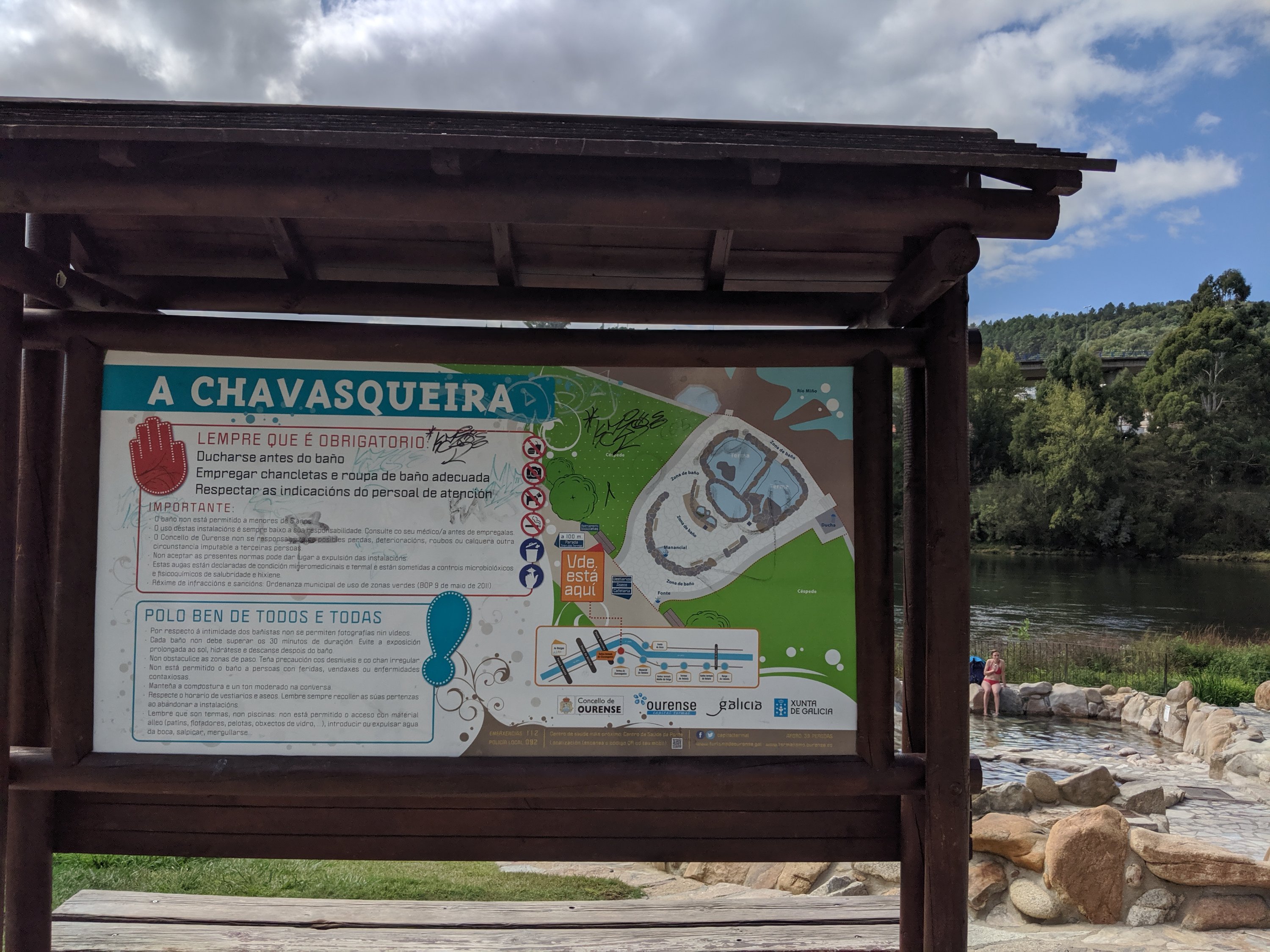
This morning the three of us left Madrid early in the morning to take the 4.5 hour train to Ourense, the starting point for our walk. There are a few natural hot springs and an old Roman thermal bath (Burgas) in the city that looks really interesting.

More so than Madrid, stores and offices here really observe their afternoon break. Nothing was open between 1 to 4:30/5:00pm except for coffee shops and a few restaurants and cerveceria. So much so that the town almost looked abandoned. I don’t mind the desolate atmosphere actually. In fact I’m very much looking forward to the silence during the walk.

I asked Pilar, her reason for doing the Camino. She has many, she said. It’s something she’s always wanted to do, she adored Santiago (St. James) whose letters are also one of her favorites in the Bible, and she sees the walk as a way to pray to God. She asked me my reason and I gave the standard answer of, oh.. I’ve always been curious about it ever since I read Paulo Coelho’s book. And I thought it’d be quite special for the three of us to spend time together on this walk. I know there’re other reasons why I’m looking forward to this walk, but it’s something I’m not able to describe in words. Not yet. Hopefully as the walk progresses, I can articulate my motivation better.

For now, I’m just grateful that the three of us are here, in good health and spirit, about to embark on this exciting journey.